How Stress During Pregnancy Affects Baby Development
There is an unspoken awareness many women carry during pregnancy.
A sense that what they feel… matters.
Not in a way that creates pressure or guilt, but in a way that invites curiosity.
Because pregnancy is not only physical.
It is neurological. Emotional. Rhythmic.
And within that experience, stress can sometimes find its way in.
Deadlines, responsibilities, uncertainty, physical discomfort, disrupted sleep. These are all real parts of modern pregnancy.
So the question becomes:
How does stress during pregnancy influence baby development?
Understanding stress through the nervous system
Stress is not just a feeling.
It is a physiological response coordinated by the nervous system.
When the body perceives stress, it shifts into a more alert state:
Heart rate increases
Breathing becomes shallower or faster
Muscles may tighten
Stress hormones, like cortisol, are released
This is a natural and necessary response.
But during pregnancy, this system becomes shared.
Your body and your baby are deeply connected through circulation, hormones and the environment you create within.
The maternal environment matters
Your baby develops within the context of your internal environment.
This includes:
Nutrient supply
Oxygen flow
Hormonal signals
Nervous system activity
When stress becomes more frequent or prolonged, it can influence this environment.
Not in a dramatic, immediate way but in subtle, cumulative ways.
This is why we begin to speak about nervous system regulation during pregnancy.
Not to eliminate stress entirely, but to support how your body moves through it.
How stress can influence baby development
1. Changes in muscle tone
Babies develop patterns of tension in utero.
When a mother’s body is often in a heightened state of stress, there may be increased muscular tone throughout her system.
This can influence how the baby positions themselves.
Some babies may be born with what we refer to as baby tension (high tone):
A tendency to feel more rigid or less relaxed
Difficulty settling
Preference for certain positions
More sensitivity to stimulation
This is not a problem to fix but a pattern to understand and support.
2. Nervous system sensitivity
The developing nervous system is constantly receiving input.
Prolonged stress exposure may influence how sensitive or reactive a baby’s system becomes after birth.
This might look like:
A baby who startles easily
Difficulty transitioning between states (awake to sleep, calm to feeding)
A need for more support to settle
Again, this is not about blame.
It is about awareness.
3. Movement and positioning in utero
Stress can also influence how the body holds itself.
If there is increased tension through the abdomen, pelvis, or diaphragm, it may subtly affect:
The space available for the baby
The baby’s movement patterns
Their positioning as they grow
This is where the physical and neurological aspects of pregnancy meet.
A gentle but important truth
Reading this, it is easy for the mind to go to:
“I’ve been stressed… have I done something wrong?”
Let’s be clear.
Stress is part of life.
A single stressful moment, or even a stressful week, does not define your baby’s development.
The body is adaptive.
Your baby is resilient.
This is not about perfection.
It is about creating more moments of support within the experience.
Supporting nervous system regulation during pregnancy
Rather than trying to remove stress entirely, the focus shifts to how your body processes and recovers from it.
This is where nervous system regulation becomes central.
1. Slowing the rhythm
Simple moments of pause such as stepping outside, slowing your breath, reducing over stimulation can signal safety to your nervous system.
2. Movement that feels good
Gentle movement such as walking, prenatal yoga, or stretching can help release physical tension and support circulation.
3. Connection
Whether it’s with your partner, your baby, or yourself, moments of connection shift the body toward a more settled state.
4. Creating space in the body
Physical ease supports neurological ease.
When the body feels less restricted, the nervous system often follows.
Where chiropractic care can support
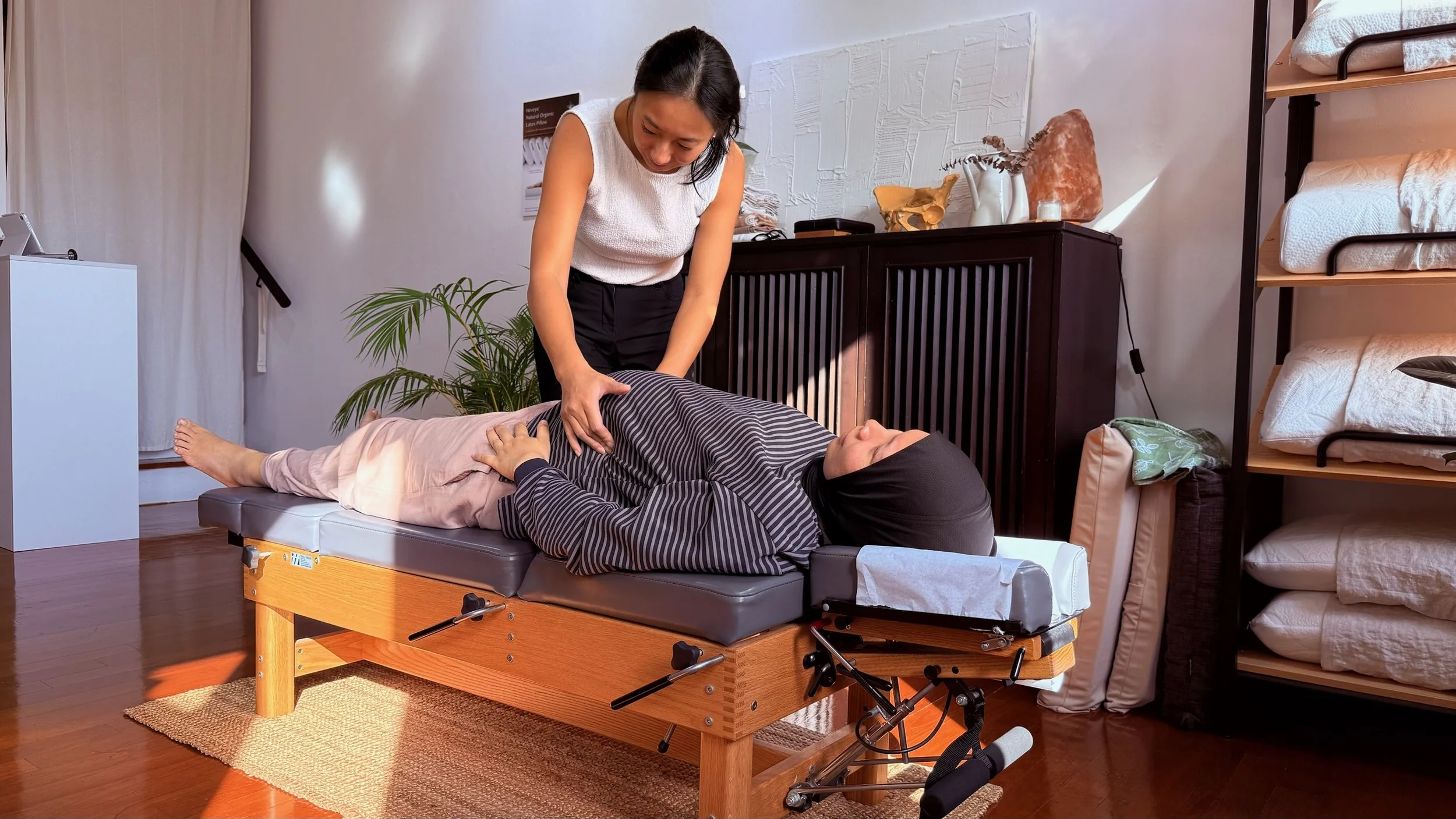
At Purely Family Chiropractic, we often support women navigating the physical, emotional and chemical changes of pregnancy.
Our approach to pregnancy chiropractic care in Joo Chiat is gentle, specific, and centred around the nervous system.
We focus on:
Reducing tension in the spine and pelvis
Supporting more balanced movement and posture
Enhancing communication within the nervous system
This can help the body shift out of constant “alert” mode and into a more regulated, adaptive state.
When your system feels more at ease, it can influence:
How you carry your pregnancy
How your body adapts to daily stressors
The internal environment your baby experiences
After birth: continuing the support
If a baby is born with signs of baby tension (high tone) or increased sensitivity, this is not the end of the story.
Babies are incredibly responsive to support.
Gentle chiropractic care for newborns can help:
Reduce areas of tension in the body
Support more balanced movement
Encourage easier settling and feeding
This creates an opportunity for the nervous system to reorganise with ease.
A different way to approach pregnancy
Pregnancy is often approached through checklists and milestones.
Appointments, scans, preparation.
But there is another layer.
A quieter one.
How you feel in your body.
How your system adapts.
How supported you are within the experience.
This is where subtle changes can have meaningful impact.
Supportive Care for Pregnancy
Stress during pregnancy is not something to fear.
It is something to understand.
A signal from the body.
A natural response to life.
And within that response, there is space to support it.
Through nervous system regulation, gentle movement, and supportive care such as pregnancy chiropractic care you can create an environment that feels more settled, more balanced, and more connected.
Not perfect.
But supported.
Because your baby is not just growing within you.
They are experiencing you.
And in that shared experience, even small moments of ease can make a difference.
At Purely Family Chiropractic, we take time to listen, observe, and assess your situation as a whole with care that is gentle and adapted to their individual needs.
If you’re curious, have questions, or simply want clarity before deciding on next steps, you’re warmly welcome to reach out or book an initial assessment. Sometimes understanding is the first and most supportive step.