Fever in Children: What It Actually Means, and How to Support Your Child Through It
There is a moment nearly every parent recognises.
You place a hand on your child's forehead. It feels warm. Too warm.
You reach for the thermometer. The number confirms it.
And almost instantly, a question follows: is something wrong?
It's a fair question. But it's often the wrong starting point.
In most cases, a fever isn't the problem. It's the body's response to one, and a fairly intelligent one at that.
For parents scanning for the essentials before reading further:
A fever is a deliberate rise in body temperature, triggered by the immune system, not a malfunction.
Most fevers in children fall between 38°C and 39.5°C, and this range tends to work in the body's favour by slowing pathogens and speeding up immune activity.
Fever after vaccination is usually a sign the immune system is learning, not a sign of illness.
The most useful things you can do at home: hydration, rest, comfort, and calm observation.
Call your doctor if your child is under 3 months old with any fever, the fever climbs above 39°C or won't settle, or your child seems unusually hard to rouse or unresponsive.
What is actually happening in the body
A normal body temperature in children sits somewhere around 36.5°C to 37.5°C. Once it climbs past 38°C, it's classified as a fever.
That rise isn't random, and it isn't the body losing control. It's directed by a small structure in the brain called the hypothalamus, which functions as the body's internal thermostat.
When the immune system detects a virus, bacteria, or a vaccine component, it releases chemical messengers called pyrogens. These signal the hypothalamus to raise the body's temperature set point on purpose.
In other words: the body isn't overheating by accident. It's adjusting the thermostat because it has decided the room needs to be warmer for a while.
Why the body chooses to do this
Raising the temperature isn't discomfort for its own sake. It changes conditions in ways that work in the child's favour.
It makes the environment harder for pathogens. Many common viruses and bacteria reproduce most efficiently at normal body temperature. A cold-causing rhinovirus, for instance, thrives in the cooler environment of the nasal passages, around 33 to 35°C. Raise the temperature, and that environment becomes less accommodating for it to multiply.
It sharpens the immune response. Research on fever-range temperatures shows they can increase white blood cell production, improve how quickly immune cells travel to infected tissue, and boost the activity of enzymes involved in fighting infection. The immune system, quite simply, works faster and more efficiently when the temperature rises.
It reorganises the body's energy. Fever rarely arrives alone. Fatigue, reduced appetite, and a pull toward rest tend to show up alongside it. These aren't side effects to push through. They're part of the same coordinated response, the body diverting energy away from digestion and activity and toward immune function.
Is there a temperature where fever "works best"?
There isn't a single number where pathogens simply stop. But there is a range where the balance tips clearly in the child's favour.
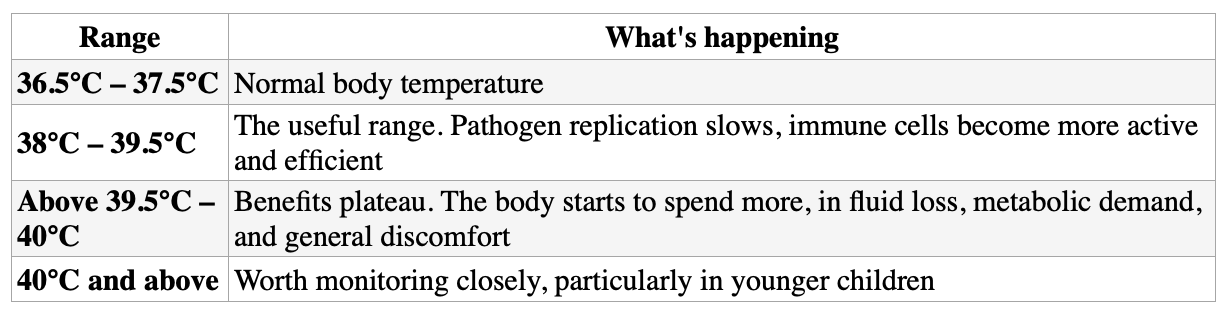
Past that upper range, the fever isn't doing more good. It's simply costing the body more. This is the point at which closer attention, and often medical guidance, becomes appropriate.
What about fever after a vaccine?
This one catches a lot of parents off guard, so it's worth separating from illness-related fever.
Vaccines work by introducing a safe form of a pathogen, or part of one, so the immune system can learn to recognise it. A mild fever afterward is often a sign that recognition is happening. The immune system is building memory, essentially rehearsing a response it may need later.
It isn't the illness itself. It's the practice run.
Why young children seem to catch fevers more often
If it feels like your child runs a fever more often than you ever did as an adult, that's not your imagination.
A child's immune system is still building its library of pathogens it recognises. Every new virus or bacteria it encounters is, in some sense, a first meeting. Each fever is part of that process of building immune memory, so the next encounter is handled faster and with less disruption.
Fever itself is not an illness. It's a signal that the immune system is doing exactly what it's supposed to be learning to do.
The nervous system's role during illness
The nervous system and immune system are in constant conversation, and fever is one of the clearer moments where you can see that.
During illness, the nervous system helps coordinate:
Temperature regulation
Immune signalling
Sleep and rest cycles
Appetite
Energy conservation
This is part of why sick children sleep more, eat less, and want to be closer to a parent than usual. It isn't a child being difficult. It's a nervous system redirecting resources toward recovery, and sleep in particular plays a specific role here, allowing the release of proteins called cytokines that help regulate inflammation.
A nervous system that can settle into this rest state tends to support a smoother recovery. One under ongoing strain may find that harder to access.
How to support your child through a fever
The goal isn't always to bring the number down as fast as possible. Often, it's to support the process already underway.
Offer fluids often. Fever increases fluid loss. Water, breast milk, formula, or clear broths all help. Small, frequent sips tend to go down more easily than a large glass at once.
Let rest happen without resistance. Sleep is where a large share of the immune work takes place. If your child wants to sleep more than usual, that's not a symptom to correct. It's the body asking for what it needs.
Dress them lightly. Heavy blankets and layers can trap heat and add to discomfort. Light clothing allows the body to regulate temperature more naturally.
Consider a lukewarm bath if they're restless. Avoid cold water or ice, which can trigger shivering and, counterintuitively, push the temperature higher.
Keep things calm. A quieter room, softer voices, less stimulation. This isn't just for their comfort. It gives the nervous system less to process, so more of its resources can go toward recovery.
Stay close. Holding them, staying nearby, lowering your own tone. During fever, children often want physical closeness more than usual, and that closeness has a regulating effect on the nervous system that goes beyond simple comfort.
Observe, rather than only measure. The thermometer gives you one data point. How your child is behaving gives you the fuller picture. Are they responsive? Drinking fluids? Able to settle, even briefly? These signs often tell you more than the number does.
When to seek medical care
Fever can be a normal, useful process, and there are still moments where professional guidance matters. Seek medical advice if:
Your child is under 3 months old and has any fever
The fever is very high (above 39°C) or persistent
Your child is difficult to wake, unusually lethargic, or unresponsive
There are signs of dehydration, such as a dry mouth or noticeably fewer wet diapers
Something simply feels off to you as a parent
That last point matters more than it might seem. You know your child's baseline better than any chart does. If your intuition is telling you something isn't right, that's reason enough to have it checked.
Where chiropractic care fits into this picture
At Purely Family Chiropractic, we're often asked whether it's appropriate to bring a child in for care while they have a fever.
Our focus is the nervous system, specifically how well it's able to regulate and adapt during periods of physical demand, and illness is one of those periods. The spine houses and protects the spinal cord, the primary communication line between brain and body. When that system is functioning without unnecessary strain, the body tends to have an easier time coordinating the processes fever depends on: temperature regulation, immune signalling, and the shift into rest.
Chiropractic adjustments are not a treatment for infection, and we're careful never to suggest otherwise. What gentle, specific care may support is the nervous system's ability to settle, which in turn may support how efficiently the body moves through recovery.
Care for infants and children at our space involves light, precise contact, often compared to the pressure used to check the ripeness of an avocado. There is no twisting or force involved. Many children relax visibly during a session, and some fall asleep entirely.
If a child is particularly unwell or uncomfortable, we adapt the visit, or reschedule it. Every child's presentation is different, and we treat it that way.
A steadier way to think about fever
It's a natural instinct to want a fever gone quickly. To restore comfort. To feel like you're doing something.
But often, the most useful thing you can do is recognise that the body is already doing something, and doing it on purpose.
Fever isn't always a sign to intervene immediately. More often, it's a sign to pay closer attention, offer support, and trust the process while watching for the moments that call for more.
Related reading: How Chiropractic Care Helps Children Grow Strong and Healthy · Why Movement Matters for Development Milestones
Frequently asked questions
Is a fever dangerous for my child?
In most healthy children, a fever within the 38°C to 39.5°C range is not dangerous. It reflects an active immune response. Danger signs relate more to your child's behaviour and hydration than to the number itself, along with any fever in an infant under 3 months.
Should I always give fever-reducing medication?
This is a personal and sometimes medical decision, best made with guidance from your pediatrician, particularly if your child is uncomfortable, unable to rest, or the fever is very high. Medication can offer comfort without necessarily interfering with the immune process, but it's worth discussing your specific situation with your doctor.
Can chiropractic care bring a fever down?
No. Chiropractic care does not treat infection or lower a fever directly. Its focus is nervous system function, which may support how the body regulates and recovers, alongside, not instead of, appropriate medical care.
Why does my child get fevers more than I do as an adult?
A child's immune system is still building recognition of the pathogens around them. Each fever is often part of that learning process, contributing to what's known as immune memory.
Is a fever after vaccination something to worry about?
A mild fever after vaccination is common and often reflects the immune system responding as intended, building recognition rather than fighting an illness.
At Purely Family Chiropractic, we take the time to listen, observe, and understand each child's situation individually. If you have questions about your child's nervous system, development, or care during illness, you're welcome to reach out or book an initial assessment.