Gentle Beginnings: How Chiropractic Care Supports Infants in Their First Year
The first year of life is a period of extraordinary change. In just twelve months, a baby transitions from curled, dependent, and largely immobile to curious, expressive, and often on the move. Beneath these visible milestones, an even more profound transformation is unfolding: the development and organisation of the nervous system.
For many parents, this year can feel both magical and overwhelming. Questions arise early:
Is my baby comfortable? Why are they unsettled? Is this normal?
At Purely Family Chiropractic, we often meet families during this tender season, not because something is “wrong,” but because they sense their baby may be holding tension, struggling to settle, or finding it hard to adapt to the world outside the womb. This is where gentle, infant-specific chiropractic care can offer meaningful support.
Let’s explore how chiropractic care for infants works, why the nervous system plays such a central role in early development, and how gentle care may support a baby’s comfort, adaptability and ease during their first year of life.
Understanding the Infant Nervous System
A baby’s nervous system begins forming early in pregnancy and continues to mature rapidly after birth. It acts as the body’s central communication network, receiving information from the environment, processing it and coordinating responses.
In the womb, babies exist in a warm, buoyant, rhythmic space with constant movement and minimal sensory demand. Birth marks a dramatic shift. Light, sound, gravity, temperature, digestion and touch all arrive at once. For some babies, this transition is smooth. For others, it can be more challenging.
When an infant’s nervous system is under stress or having difficulty adapting, parents may notice signs such as:
Difficulty settling or frequent crying
Preference for turning the head to one side
Feeding challenges or discomfort after feeds
Sleep that feels restless or fragmented
A body that appears stiff, tense or unusually floppy
Poor pooping habits. Think watery stools, no bowel movement.
These signs are not diagnoses, they are dys/regulated nervous system communication. They often reflect how a baby’s nervous system is processing their new environment.
What Is Chiropractic Care for Infants?
Chiropractic care for infants is entirely different from adult chiropractic care.
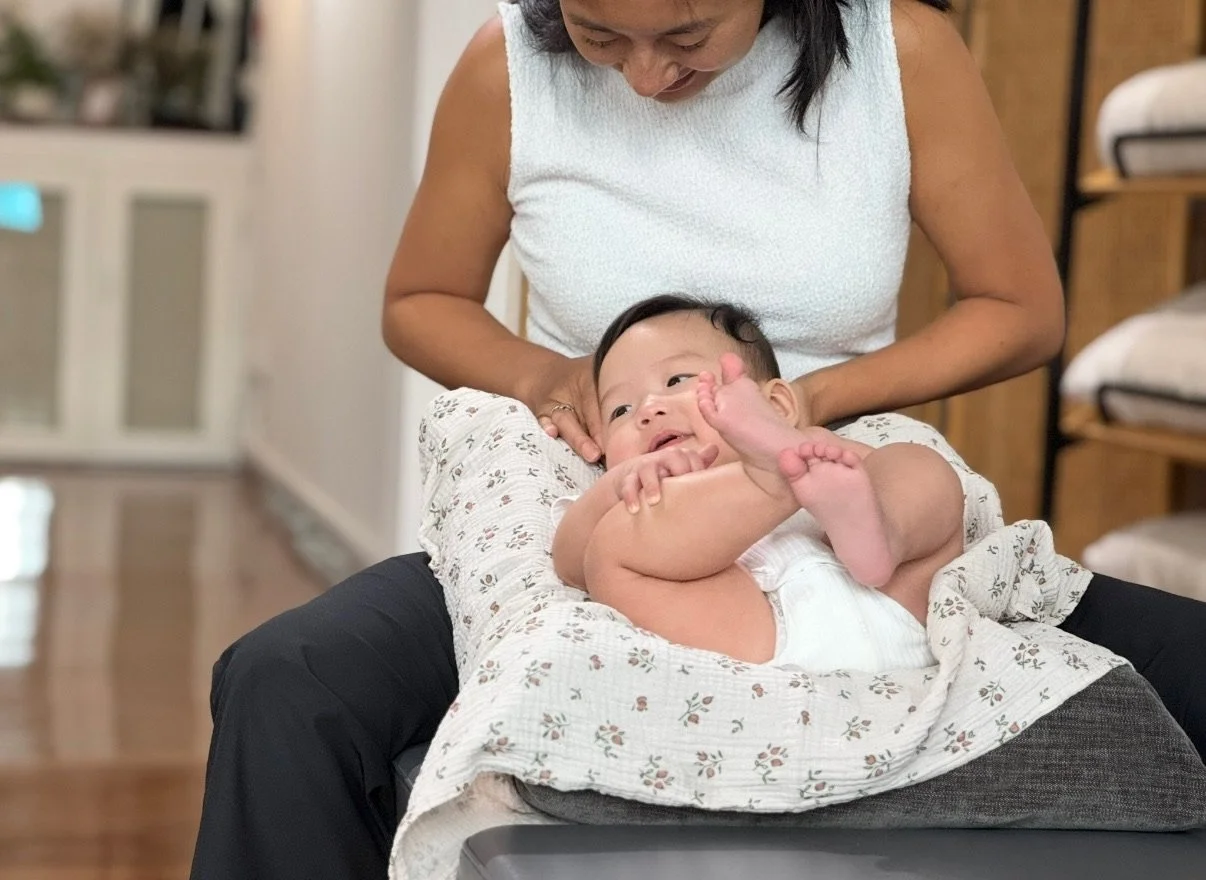
There is no cracking, popping or forceful movement. Infant adjustments are gentle, precise, and specific, using pressures similar to checking the ripeness of a peach or lightly testing the surface of a tomato.
The intention is not to “fix” or “correct,” but to support the nervous system’s ability to organise and respond more smoothly.
At Purely Family Chiropractic, care is always adapted to the baby’s age, size, birth history and individual presentation. Each session is led by observation and respect for the baby’s cues.
Birth, Tension and the Baby’s Body
Birth, whether vaginal or caesarean, is a physically intense experience. During labour, a baby’s head, neck, shoulders and body undergo sustained pressure, rotation and compression. Even when birth is calm and uncomplicated, it is still a significant physical event.
In some cases, birth experiences may include:
Long or fast labours
Assisted deliveries (forceps or vacuum)
Caesarean birth (elective or emergency c-section)
In-utero positioning constraints
Twin pregnancies
These experiences can contribute to areas of tension or restriction in a baby’s body, particularly around the head, neck and spine - areas closely connected to the nervous system.
When these areas are under strain, the nervous system may receive mixed or distorted information, which can influence how comfortably a baby moves, feeds, sleeps, digests and settles.
Baby Tension and Comfort: What Parents Often Notice
One of the most common reasons families seek chiropractic care for infants is a sense that their baby is uncomfortable, even when medical checks are clear.
Parents often describe things like:
“My baby seems tense when I hold them.”
“They arch their back a lot.”
“They never seem fully relaxed.”
“Something just feels off, but I can’t explain it.”
Babies express tension and discomfort through their bodies, not words. Subtle asymmetries, preferences or persistent discomfort can indicate that their nervous system is working harder than it needs to.
Gentle chiropractic care aims to reduce unnecessary strain on the baby, allowing the body and nervous system to communicate more clearly, often resulting in improved ease and comfort.
Feeding, Sleeping, Digestion, and the Nervous System
Feeding is one of the most complex tasks an infant performs. It requires coordination between the brain, cranial nerves, jaw, tongue, neck and digestive system.
When a baby is under tension, parents may notice:
Difficulty latching or maintaining a latch
Feeding fatigue
Gassiness or discomfort after feeds
Reflux-like symptoms
The nerves involved in feeding and digestion exit the brainstem and travel through the neck. Gentle pediatric chiropractic care focuses on reducing tension for babies in these areas, supporting clearer communication between the brain and the digestive system.
It’s important to note that chiropractic care does not replace lactation support or medical care. Instead, it often works alongside other professionals, supporting the physical and neurological foundations that feeding depends on.
Sleep and Regulation in the First Year
Sleep in infancy is not just about rest. It is an essential component for brain development and nervous system integration.
Many parents expect newborn sleep to be unpredictable, and that is true. However, when sleep feels persistently restless or difficult, it can signal that the nervous system is struggling to downshift into calmer states.
The nervous system has two primary modes:
Alert / protective mode
Rest / digest / repair mode
When a baby spends more time in an alert state, settling and staying asleep can be difficult. Gentle chiropractic care supports the nervous system’s ability to move more fluidly between these states, often helping babies settle more easily and rest more deeply.
Development, Movement and Early Milestones
Movement is one of the primary ways a baby’s nervous system develops. Rolling, reaching, pushing up, crawling, and eventually walking all require coordination between the brain, spinal cord, muscles and joints.
When there is tension or restriction in the spine or nervous system, movement patterns may feel less organised or less symmetrical.
Parents might notice:
Preference for one side
Difficulty during tummy time
Delayed or uneven movement patterns
Scooting when attempting to crawl
Chiropractic care does not “teach” milestones. Instead, it aims to remove barriers that may be making movement harder, allowing a baby’s natural development to unfold with greater ease.
What a Session Looks Like at Purely Family Chiropractic
For many parents, the idea of chiropractic care for infants feels unfamiliar. A session is designed to feel calm, unhurried, and respectful for both baby and parent.
1. Listening First
We begin by listening. Pregnancy, birth, feeding, sleep, and your observations all matter. Parents know their babies best.
2. Gentle Assessment
Using light touch and observation, we assess movement, tension patterns, and nervous system responses.
3. Specific, Gentle Care
If care is appropriate, adjustments are subtle and tailored to your baby’s needs. Many babies remain relaxed, feed, or sleep during sessions.
4. Ongoing Support
Care is never one-size-fits-all. Frequency and duration are based on your baby’s responses and developmental stage.
Is Chiropractic Care Safe for Infants?
When provided by a practitioner trained specifically in paediatric chiropractic care, infant chiropractic is gentle and appropriate for this stage of life.
At Purely Family Chiropractic, Dr Clara has extensive training in paediatric and perinatal care, with a strong emphasis on safety, consent and nervous system-based approaches.
Parents are always welcome to ask questions, observe closely, and take time to feel comfortable with the process.
Why Families in Singapore Seek Infant Chiropractic Care
Families seeking chiropractic care for infants in Singapore often do so because they value:
Preventative, gentle approaches
A nervous system-centred perspective
Care that sees the baby as a whole being, not a list of symptoms
In a fast-paced environment, many parents are looking for ways to support their baby’s ability to adapt, settle and thrive amidst stimulation and change.
A Gentle Foundation for Life
The first year of life lays the groundwork for everything that follows. When a baby feels more at ease in their body, their nervous system can focus on what it does best: learning, adapting, and growing.
Chiropractic care for infants is not about chasing milestones or correcting problems. It is about supporting clarity, comfort, and connection within the nervous system so that a baby’s earliest experiences are built on a foundation of ease.
If you are curious, uncertain, or simply wanting to understand your baby better, seeking guidance can be a meaningful first step.
At Purely Family Chiropractic, we are honoured to walk alongside families during these gentle beginnings.