The Nervous System and Emotional Regulation in Children
Don’t abandon me in my rage (tantrums)
There are moments in early parenthood that feel disarming.
Your child is on the floor, crying intensely. Their body is tense, their voice loud, their movements unpredictable. You try to reason, to soothe, to redirect, but nothing seems to land.
It can feel overwhelming. It can feel personal. It can feel like something is going wrong.
But what if we looked at tantrums differently?
Not as misbehaviour.
Not as manipulation.
But as a reflection of a child whose nervous system is overwhelmed.
What is really happening during a tantrum?
A tantrum is not simply a behavioural outburst. It is a physiological event.
When a child’s nervous system becomes overwhelmed, their body looks for a way to release that internal pressure. That release can appear as yelling, screaming, kicking, hitting, or intense crying.
This tends to begin around 12 to 18 months of age and is commonly seen between 2 and 4 years old, right at the stage where children are developing independence, curiosity, and emotional depth… but without yet having the internal tools to process it all.
At its core, a tantrum is not about control.
It is about capacity.
The child is experiencing more than they can manage.
The gap between emotion and regulation
Children feel deeply.
Their joy is expansive. Their curiosity is limitless. And equally, their frustration, disappointment, and fatigue can feel all-consuming.
But while their emotional world is rich, their ability to regulate those emotions is still developing.
This creates a gap: Big feelings, small capacity to process them.
When that gap becomes too wide, the nervous system shifts into a state of overwhelm.
And when the nervous system is overwhelmed, regulation is no longer accessible.
Why does the nervous system become overwhelmed?
There is rarely a single reason. More often, it is a layering of factors that build throughout the day.
A child may experience a tantrum because:
They want something that is not allowed
They are attempting something beyond their current abilities
They cannot yet communicate their needs or desires clearly
They are physically depleted (hungry, tired, overstimulated)
They are seeking connection and cannot access it in that moment
Individually, these may seem small. But within a developing nervous system, they can accumulate quickly.
Imagine trying to articulate a complex emotion without the words to do so.
Imagine feeling tired, hungry, and overstimulated, while also being told “no.”
The body takes over where words cannot.
The nervous system response: fight, flight, or freeze
During a tantrum, the child is not calmly choosing their actions.
Their nervous system has shifted into a stress response.
This can look like:
Fight: hitting, kicking, pushing, yelling
Flight: running away, avoiding, trying to escape
Freeze: shutting down, withdrawing, becoming unresponsive
In these moments, the part of the brain responsible for reasoning and logic is not leading.
The body is.
Which is why explanations, instructions, or discipline often do not work in the middle of a tantrum.
The child is not in a place to receive them.
“Don’t abandon me in my rage”
If we could translate what a child is expressing during a tantrum, it might sound something like:
“This is too much for me.”
“I don’t know how to come back from this.”
“Stay with me while I find my way.”
Even when a child pushes you away, arches their back, or yells “no,” there is often a deeper need beneath it:
Connection.
Safety.
Grounding.
This is where the role of the parent becomes essential—not to fix the emotion, but to support the child through it.
What helps in the moment?
When the nervous system is overwhelmed, it does not respond to logic.
It responds to presence.
1. Stay regulated yourself
Children borrow regulation from the adults around them.
Your tone, your breath, your body language. All of it communicates safety or threat.
This does not mean you need to be perfectly calm.
It means being aware enough to soften your voice, slow your movements, and remain steady.
2. Offer physical connection
At the peak of a tantrum, the body is tense.
A warm, grounded hug can provide the containment the nervous system is seeking.
Even if your child resists at first, stay close.
Offer your presence without force, but with consistency.
Sometimes the message is not “hold me tightly,” but rather, “stay near enough that I know I am not alone.”
3. Reduce stimulation
Bright lights, loud environments, multiple voices. These can intensify overwhelm.
Whenever possible, bring your child into a quieter, calmer space.
Less input allows the nervous system to begin settling.
4. Use simple language
Long explanations can feel like more pressure.
Short, reassuring phrases are more effective:
“I’m here.”
“You’re safe.”
“I’ve got you.”
These anchor the child without overwhelming them further.
After the storm: what happens next?
Once the tantrum has passed, the nervous system begins to return to a more regulated state.
This is when connection deepens.
Rather than correcting or disciplining immediately, consider:
Reconnecting through closeness
Naming the emotion gently (“That felt really big, didn’t it?”)
Offering reassurance without judgment
This helps the child begin to build awareness around their emotions over time.
Not in the moment of overwhelm, but in the calm that follows.
Regulation is learned through relationship
Children are not born knowing how to regulate their emotions.
They learn through repeated experiences of being supported through them.
Each time you stay present during a tantrum, you are teaching something profound:
That emotions can be felt without losing connection
That overwhelm can pass
That they are safe, even in intensity
Over time, these experiences shape how the nervous system responds to stress.
They become internalised.
The role of the body in emotional regulation
We often think of emotions as something happening in the mind.
But for children, emotions are deeply physical.
They feel them in their bodies, in their muscles, their breath, their posture.
When the nervous system is overwhelmed, the body reflects it: tightness, restlessness, agitation.
Supporting regulation, therefore, is not only about behaviour or communication.
It is also about supporting the body.
How chiropractic care can support regulation
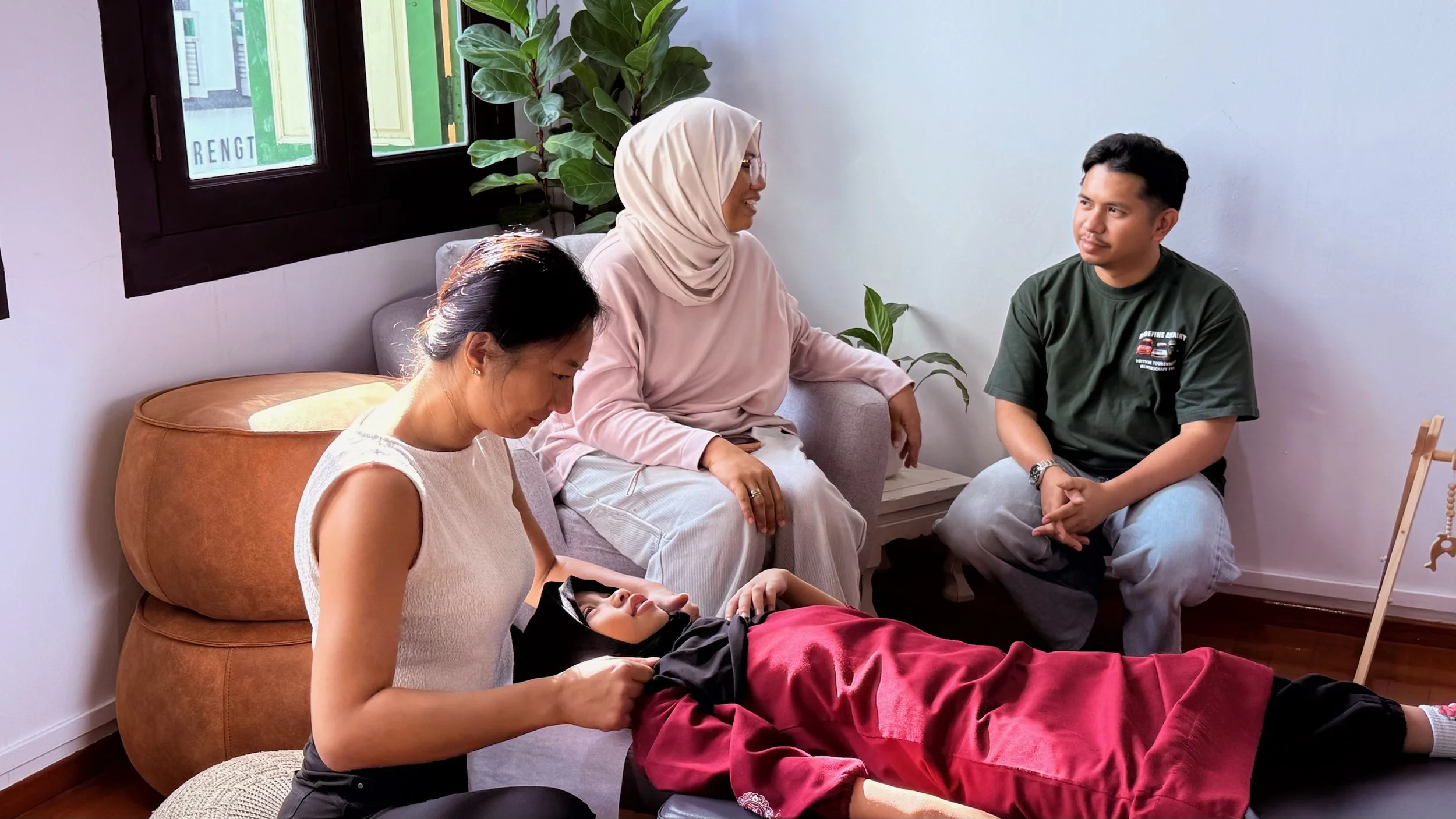
At Purely Family Chiropractic, we look at the nervous system as the foundation through which children experience and respond to their world.
Gentle, specific chiropractic adjustments are designed to support the balance between different branches of the nervous system, particularly the shift toward a more settled, grounded state.
When the nervous system is better able to adapt:
Children may find it easier to transition between activities
Their tolerance to stressors can improve
Their ability to settle, rest, and connect may deepen
This is not about eliminating emotions.
It is about creating more capacity to move through them.
Our approach is always gentle, precise, and adapted to the child’s age and stage of development while respecting their body and their individuality.
A different perspective on tantrums
It is easy to see tantrums as something to stop.
But what if we saw them as something to understand?
A signal rather than a problem. A message rather than a mistake.
When we shift this perspective, our response changes.
We move from: “Why is my child behaving like this?”
To: “What is my child’s nervous system experiencing right now?”
And from there: “How can I support them through it?”
Supporting yourself as a parent
There is an important truth that often goes unspoken:
Being with a child through a tantrum can be deeply triggering.
It can bring up frustration, helplessness, even anger.
This does not make you a bad parent.
It makes you human.
Supporting your child’s regulation begins with tending to your own.
Taking moments to pause, to breathe, to step back when needed. These are not luxuries. They are essential.
Because the more supported you feel, the more capacity you have to support your child.
Have you considered chiropractic care for yourself? Allowing you to respond with more calm and patience with your little one.
When to seek additional support
While tantrums are a normal part of development, there are moments when additional support can be helpful.
If you notice:
Tantrums that are very frequent or prolonged
Difficulty settling even after the episode
Challenges with sleep, feeding, or transitions
A child who seems consistently on edge or easily overwhelmed
It may be worth exploring through chiropractic care how their nervous system is functioning and adapting.
Reach out or book an initial assessment.