Most parents notice posture the same way. A child is hunched over a book, or slouched in front of a screen, and the instinct is to say something. Sit up straight. Shoulders back. It's said kindly, usually, but it's said often, and it rarely seems to stick for more than a few minutes.
If you've been having some version of this conversation for months, it's worth asking a different question than the one most of us start with. Not "why won't they sit up straight," but "why can't they, easily, for very long." Those are different problems, and they call for different responses.
It's Not Really About Sitting Up Straight
Posture is often treated as a habit, something a child picks up or fails to pick up, like remembering to say please. But posture isn't primarily a behaviour. It's the visible result of how well a child's nervous system is organising their body against gravity, moment to moment, without them thinking about it at all.
A child with efficient postural control doesn't decide to sit up straight. Their body simply holds that position with very little effort, because the muscles doing the work are getting clear, steady signals about where the body is in space. When that signalling is less efficient, sitting upright takes real effort. It's tiring in a way that isn't obvious from the outside. So the child slumps, not because they've stopped trying, but because holding themselves upright was never effortless to begin with.
This reframe matters, because it changes what we're looking for. We're not looking for a child who needs more reminders. We're looking for a child whose body might be working harder than it should have to, for something as basic as sitting at a table.
The Signs Are Usually Easy to Miss
Posture problems in children rarely announce themselves. They tend to show up as small, easy-to-explain-away details, the kind that could mean anything on their own but start to form a pattern when you notice a few together.
In younger children, this can look like a strong preference for W-sitting, where the knees point forward and the feet tuck out behind, because it offers more stability than sitting cross-legged does, and is usually an easier transition when transitioning from crawling to sitting. Later, it can look like a toddler who tires quickly on walks and asks to be carried well before you'd expect, or one who seems to lean on furniture more than you'd think necessary for balance.
In school-age children, the signs shift. One shoulder sits visibly higher than the other, especially by the end of a school day. A child rests their head on one hand while writing, not occasionally but as a consistent habit. Their school bag always goes on the same shoulder, and they resist switching, because the other side genuinely feels less stable. Shoes wear down unevenly at the heel. A child seems restless in a chair, shifting every few minutes, not out of impatience but because staying still in one position has become uncomfortable faster than it should.
None of these signs are alarming on their own. Most children do a few of them at some point. What's worth paying attention to is consistency, the same pattern showing up across different settings and over time, rather than a single afternoon of slouching after a long day.
Where This Often Starts Younger Than You'd Think
It's tempting to treat posture as something that develops in the school years, once a child is sitting at a desk for long stretches. In practice, the groundwork is laid much earlier, often in infancy.
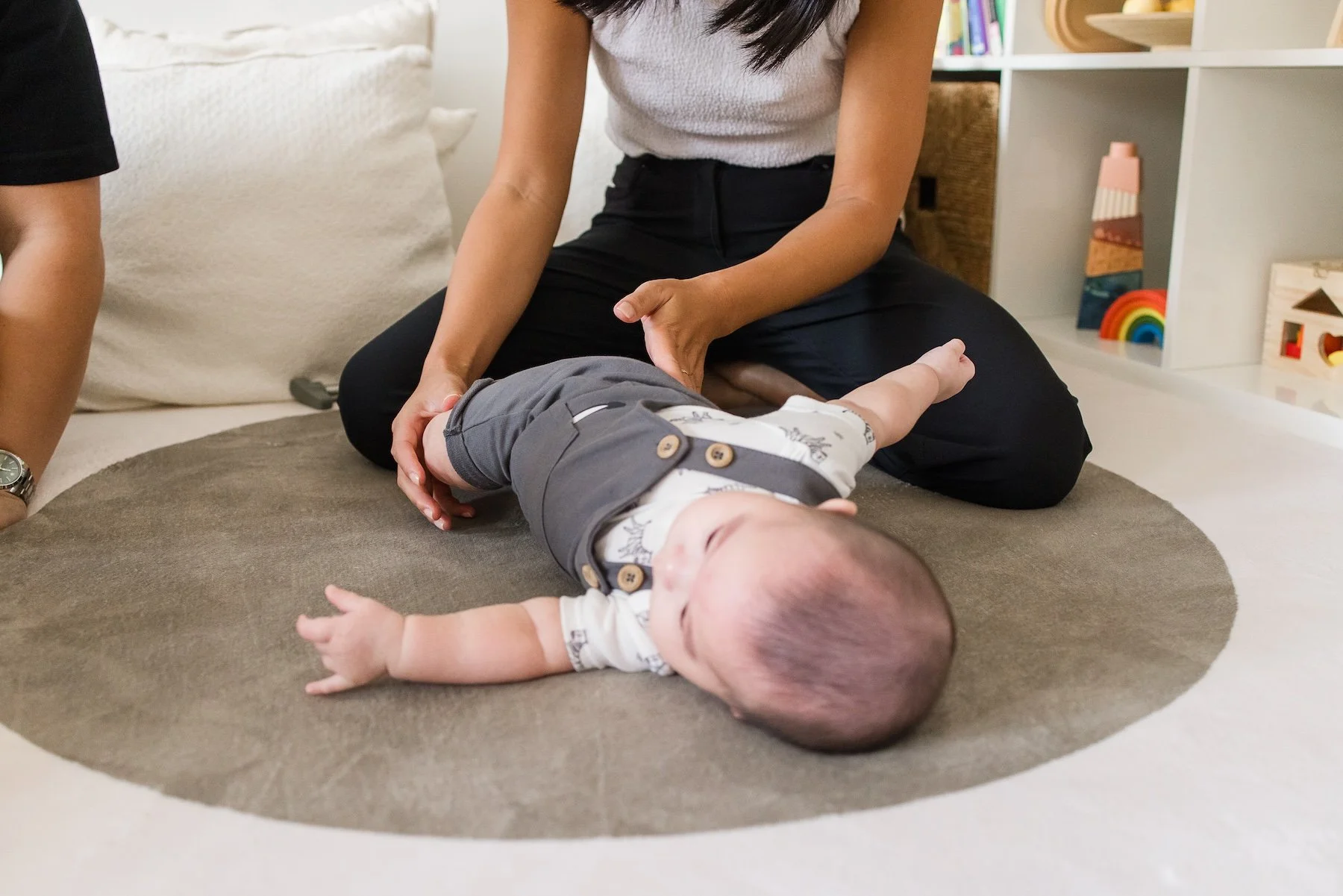
Tummy time, crawling, pulling to stand, and early walking aren't just milestones to check off. Each stage asks a baby's nervous system to organise a new relationship with gravity, and each one builds on the last. A baby who skips or shortens a stage, for whatever reason, sometimes simply preference, sometimes something more, moves into the next stage with slightly less of that groundwork in place. It's rarely a single moment that explains a posture pattern years later. It's more often a slow accumulation, starting well before a child ever sits at a desk.
This is part of why we pay close attention to the early months in a family's care, not because every early pattern predicts a later one, but because the nervous system's job of organising the body starts far earlier than most people expect.
What This Has to Do With the Nervous System
The muscles that hold a child upright, the small stabilising muscles along the spine, around the shoulders, through the core, aren't muscles a child consciously controls the way they control, say, kicking a ball. That kind of postural work runs mostly in the background, coordinated by the nervous system using constant feedback from the joints, the inner ear, and the eyes.
When that feedback loop is working efficiently, sitting upright takes almost nothing. When it isn't, a child's body compensates, often by locking certain muscles into overwork while others go underused. Over time, that compensation becomes the pattern you can see. The uneven shoulders, the head tilt, the constant shifting in a chair. It's not that the child has bad posture in isolation. It's that their body has found a workaround for a system that isn't communicating quite as efficiently as it could.
This is the piece that's easy to miss when posture gets treated as a discipline issue. A child who's told to sit up straight fifty times a week isn't lacking motivation. They're being asked to consciously override something their nervous system was supposed to handle without being asked.
What We Look At In Our Chiropractic Space
When a family comes to us with concerns about posture, we're not looking to correct a single visible habit. We're looking at how a child's whole nervous system is coordinating movement, which usually means watching them move in ways that have nothing to do with sitting at a desk. How they walk. Where are the toes pointing at. How they get up off the floor. Which side they favour without noticing. Where tension has built up, and where the body seems to be working harder than it needs to.
From there, care is gentle and specific to what we find in that particular child. No two children carry tension in the same place, or for the same reasons, so there's no standard routine we apply across the board. The aim isn't to force a child into a straighter position. It's to support the nervous system's own ability to organise posture more efficiently, so that sitting upright becomes less effortful rather than something a child has to be reminded into.
What Parents Can Watch For at Home
If you're wondering whether what you're seeing is worth a closer look, a few things are worth paying attention to over the coming weeks rather than a single day.
Notice whether one side is consistently favoured, in how your child carries a bag, holds a pencil, or turns to look at you. Notice how long they can sit at a table before they start shifting or sliding down in the chair. Notice whether they seem more tired than expected after a day that wasn't especially physical. And notice, gently, whether reminders to sit up straight seem to work for a minute and then fade, which often says more about effort than attitude.
None of this is meant to turn you into someone constantly assessing your child. It's more about trusting a pattern you've already half noticed, rather than dismissing it because it seems too small to matter.
A Calm Close
Posture in children is rarely about willpower, and it's almost never about a single bad habit that needs correcting. More often, it's a subtle signal from a nervous system that's working a little harder than it needs to, in a body that's still learning how to organise itself against gravity.
You don't need to overhaul anything at home, and you don't need to treat a slouch as a warning sign. What's useful is simply paying attention, the way you already do with so much else about your child, and asking someone to take a closer look if the pattern feels persistent rather than passing. That's a reasonable thing to be curious about, and it's the kind of question a chiropractic space built around children and their nervous systems is well suited to help you think through.
Purely Family Chiropractic is a boutique pediatric and family chiropractic space along Joo Chiat Road, Singapore, focused on gentle, nervous system-informed care for children and their parents.