When Your Baby Only Looks One Way: Understanding Torticollis Early
There’s a moment many parents notice quietly.
Your baby is resting… and their head gently turns to one side.
Then again.
And again.
You try to engage them from the other side, but they seem to return to their “favourite” position.
At first, it feels like a small preference. But over time, you begin to wonder:
Is this normal? Should I be concerned?
This is often how torticollis begins to show itself.
Not loudly. But subtly, through patterns.
What is torticollis?
Torticollis refers to a condition where a baby develops a head preference, often accompanied by a tilt or rotation of the neck.
You might notice:
Your baby consistently turning their head to one side
Difficulty looking the other way
A slight tilt of the head
Preference when feeding from one side
Early flattening on one side of the head
Prefers to look to the same side when sleeping
At its core, torticollis is not just about the neck.
It is about how the body, and the mostly the nervous system, are organising movement.
Why does head preference happen?
There is rarely a single cause.
More often, torticollis is the result of multiple factors coming together, especially around the birth process and early development.
1. The birth process
Birth, even in the most supported environments, is a physically intense experience for both mother and baby.
During delivery, a baby’s head and neck may experience:
Compression
Rotation
Prolonged positioning in the birth canal
Assistance (such as forceps or vacuum in some cases)
These forces can sometimes lead to neck restriction, where certain muscles or joints feel tighter or less mobile.
This doesn’t mean something has gone wrong.
But it may influence how easily your baby moves their head in the early weeks.
2. Positioning in the womb
Some babies spend extended time in one position during pregnancy.
Limited space or positioning patterns can contribute to:
A preference for turning one way
Tightness on one side of the neck
Early asymmetry in movement
Again, this is not something to blame.
It is simply part of how your baby has adapted.
3. Early environment
After birth, babies spend a significant amount of time lying on their backs (especially with safe sleep recommendations).
If a baby already has a slight preference, this position can reinforce it over time.
Small patterns become stronger when repeated.
Why does it matter?
A head preference might seem minor at first, but over time, it can influence more than just the neck.
Because the body is constantly developing.
When one area is restricted, other areas begin to adapt.
This is where we start to see patterns of compensation and adaptation.
1. Impact on head shape
Consistently resting on one side can lead to flattening of the skull (often referred to as positional plagiocephaly).
More than just cosmetic, it reflects how the baby is using (or not using) certain movement patterns.
2. Feeding and latching
Babies with neck restriction may find it easier to feed on one side than the other.
You might notice:
Difficulty latching on one breast
Fussiness during feeding
Preference for a particular position
3. Motor development
Movement builds on movement.
If a baby has limited ability to turn their head both ways, it may influence:
Rolling
Reaching
Crawling patterns
Over time, this can shape how the body develops strength and coordination.
What does torticollis look like in real life?
It doesn’t always present dramatically.
Sometimes, it’s simply:
A baby who always looks to the right
A slight tilt when held upright
One side that feels “easier” than the other
Other times, it becomes more noticeable as the baby grows and movement demands increase.
The key is not to wait for it to become obvious.
Early awareness allows for gentle, effective support.
Supporting your baby at home
There are simple ways to begin encouraging more balanced movement.
1. Change positioning
Alternate the direction your baby lies in the cot.
Babies often turn toward light or stimulation, so changing their orientation can encourage them to look the other way.
2. Engage from the non-preferred side
Place toys, faces, and voices on the side your baby avoids.
Make that side interesting, inviting, and worth exploring.
3. Increase tummy time
Tummy time helps strengthen the neck and upper body, encouraging active movement in both directions.
Start small, and build gradually.
4. Be mindful during feeding and carrying
Switch sides regularly.
This allows your baby to experience different positions and movements throughout the day.
Where chiropractic care can support
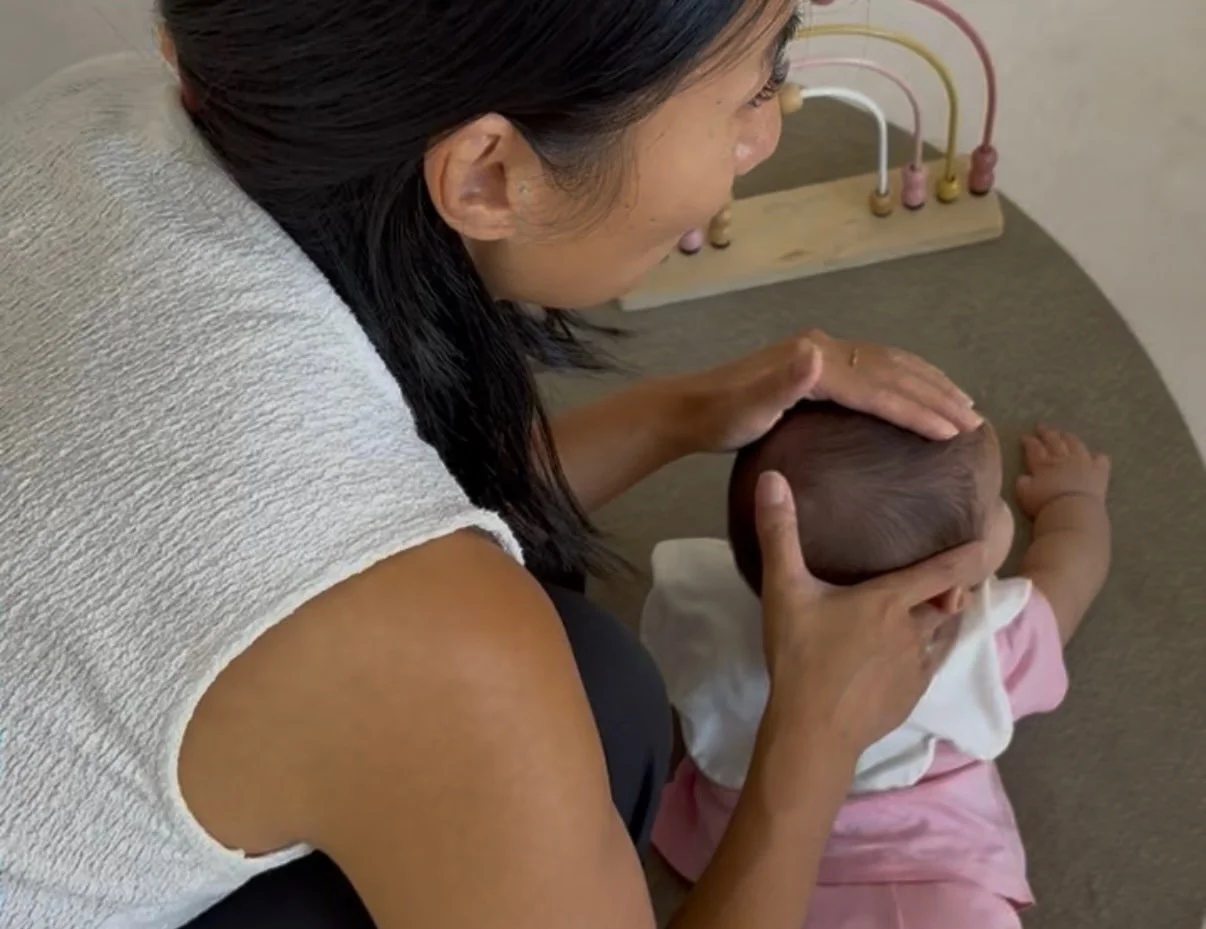
At Purely Family Chiropractic, we often help babies with torticollis or early head preference.
Our approach is gentle, specific, and adapted to your baby’s stage of development.
We look at:
How your baby moves
Where there may be neck restriction
How the nervous system is coordinating these patterns
Rather than forcing movement, we support the body in finding more ease and balance.
This may help:
Improve range of motion in the neck
Reduce tension in surrounding tissues
Support more symmetrical movement patterns
More symmetry in the head shape
Care is always soft, precise, and respectful of your baby’s body.
Why early support matters
Babies are incredibly adaptable.
Their bodies are constantly learning, adjusting, and growing.
This is what makes early intervention so powerful.
When we support the body early:
The skull is at its softest
Patterns are easier to shift
Compensation is less established
Development can unfold more smoothly
It’s not about correcting something “wrong.”
It’s about guiding the body back toward balance while it is still learning.
A different way to see torticollis
It’s easy to label torticollis as a condition to fix.
But what if we saw it as a message?
A signal from the body that something feels easier one way than the other.
And within that signal, an opportunity:
To observe
To support
To gently guide
If your baby has a head preference, or you’re noticing early signs of neck restriction, you are not alone.
These patterns are common.
And they are often very responsive to gentle, thoughtful support.
The goal is not perfection.
It is balance.
Ease.
Freedom of movement.
Because when your baby can turn both ways, they begin to explore the world more fully.
And that’s where development truly opens up.
Reach out or book an initial assessment.